I feel quite chuffed to see THREE photographs of myself on the NLM blog
See if you can identify me!
skip to main |
skip to sidebar
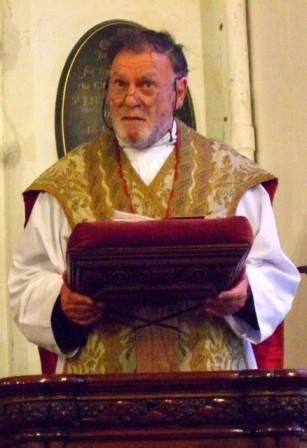
was for nearly three decades at Lancing College; where he taught Latin and Greek language and literature, was Head of Theology, and Assistant Chaplain. He has served three curacies, been a Parish Priest, and Senior Research Fellow at Pusey House in Oxford. Since 2011, he has been in full communion with the See of S Peter. The opinions expressed on this Blog are not asserted as being those of the Magisterium of the Church, but as the writer's opinions as a private individual. Nevertheless, the writer strives, hopes, and prays that the views he expresses are conformable with and supportive of the Magisterium. In this blog, the letters PF stand for Pope Francis. On this blog, 'Argumentum ad hominem' refers solely to the Lockean definition, Pressing a man with the consequences of his own concessions'.
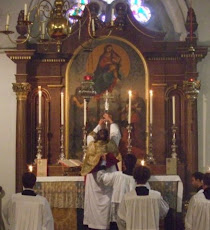
... once graced the high altar of the church of Sancta Maria in Ara Coeli on the Capitoline Hill.


Fr John Hunwicke
was for nearly three decades at Lancing College; where he taught Latin and Greek language and literature, was Head of Theology, and Assistant Chaplain. He has served three curacies, been a Parish Priest, and Senior Research Fellow at Pusey House in Oxford. Since 2011, he has been in full communion with the See of S Peter. The opinions expressed on this Blog are not asserted as being those of the Magisterium of the Church, but as the writer's opinions as a private individual. Nevertheless, the writer strives, hopes, and prays that the views he expresses are conformable with and supportive of the Magisterium. In this blog, the letters PF stand for Pope Francis. On this blog, 'Argumentum ad hominem' refers solely to the Lockean definition, Pressing a man with the consequences of his own concessions'.
Archive
-
▼
2009
(332)
-
▼
September
(25)
- Greek lesson
- Did Christians ever worship inthe vernacular?
- ME!
- Pope Benedict
- Meddling galore
- Do it yourself
- Catullus and the Continuum
- English Missal
- VERSUS OCCIDENTEM
- Via Nordica Media
- Embers???
- Consecration
- REFORM OF THE REFORM: THE BREVIARY
- Irish referendum
- Married Priests: Practicalities
- Hierarchy
- CROUCHMAS
- Married Priests
- Our Lady of Oseney
- Local Sanctity
- ANGLICANISM
- ELEPHANTS AGAIN: SEDEVACANTISM
- Was Gregory Organic?
- Hermeneutics
- PLURA DIXIT
-
▼
September
(25)
Popular Posts
-
More Update: Perhaps I should have been more explicit about the complete wrongheadedness of the sort of speculations which could be triggere...
-
There are wild rumours on the Internet about News due to break tomorrow, Sunday. They are, as far as I know, all wrong. Far too wild. Far to...
-
To refresh your memories, I reprint a piece I wrote when an earlier electronic edition of the Dictator Pope was published under a pseudonym:...
-
So a correspondent wrote on one of my threads. It set me thinking. I am convinced that PF is most certainly not the worst man ever to hav...
-
Perhaps a couple of years ago, in Western Ireland, I had the privilege to be in the company of a very great prelate just after he had offere...
-
"After this Magisterium, after this long journey, we can affirm with certainty and with Magisterial authority that the Liturgical Refor...
-
Lead us not into temptation. It is unlikely that the Greek and Latin words translated by temptation meant the sort of thing we mean by '...
-
Pope Francis breaks his silence! A "In authorising regular use of the older Mass, now referred to as the 'extraordinary form'...
-
The heart of the Bergoglianist error is, in my fallible opinion, to be found in such texts as the letter Archbishop Nichols wrote last year ...
Followers
Links
Raffaello's Madonna di Foligno
... once graced the high altar of the church of Sancta Maria in Ara Coeli on the Capitoline Hill.
6 comments:
Yes, you are the improperly dressed cleric in choir on the Epistle/Decani side:
a) wearing a biretta rather than holding your cap;
b) wearing a strange white square-necked garment instead of your duly appointed choir dress of a proper surplice and tippet.
c) Is there a prize?
I thought to look first under the article on "Anglo-Saxon Find in Staffordshire", but I gather instead you are in the solemn profession of Br. Lawrence Lew, OP, in choir dress. Keep up the good work!
You did say a photograph, not a fresco or an icon, didn't you...Oh! There you are!
Looks as though you are quite enjoying the Stanford! I love it too! Such sweet Protestant musik.
Just look at the third photo while listening to this...
http://www.youtube.com/watch?v=66EfWRLs5kw
(Everything's better with a soundtrack.)
Good heaven's Father! You look younger and more gtrim in those pics than you do in the one you supply for this site.
Now that is surely for the good as it suggests that you will be around longer, dishing out the results of your valuable research.
But on the other hand, does this mean that you don't speak with a sort of deep growl and manifest the miner eccentricities of an aging British scholar?
It's apparent, Father, that I shall have to completely re-imagine you! Sigh!
An other typo! The word in the second line is trim NOT grim. I don't think I can assume that the right meaning would have been taken in this context as I suppose either word could make sense.
Sorry!
Post a Comment